
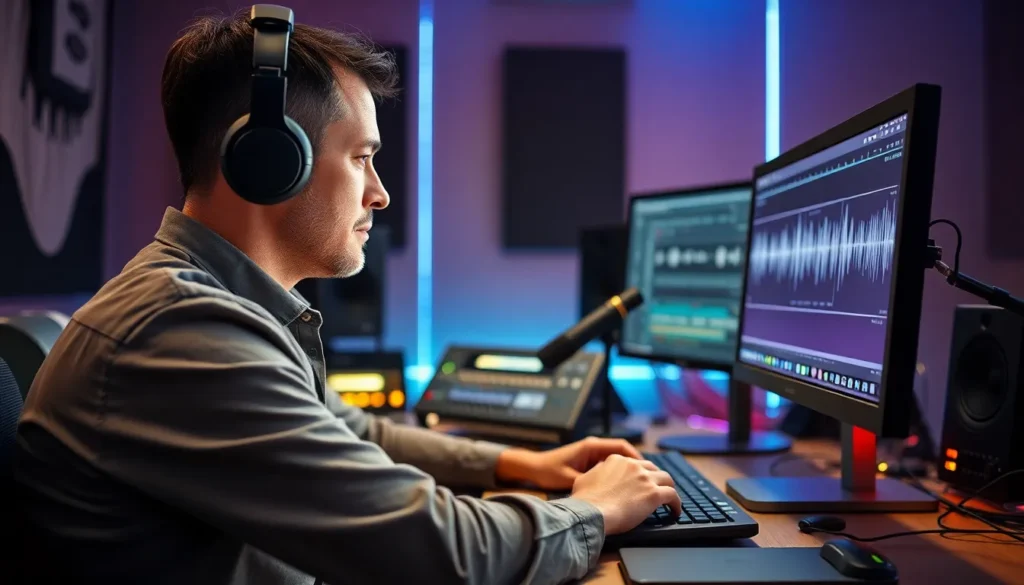

Ever tried listening to your favorite song only to be greeted by the dreaded sound of distortion? It’s like biting into a chocolate bar only to find out it’s filled with broccoli. Declipping audio might sound like a high-tech wizardry, but it’s really just a way to rescue those poor, clipped sounds and bring them back to life.
Overview of Declipping Audio
Declipping audio involves restoring sound that has become distorted due to clipping. Clipping occurs when audio levels exceed the maximum threshold of a recording device, creating unwanted artifacts. This phenomenon affects the quality of music, speech, and other audio forms.
Many audio engineers use specialized software to identify and fix clipped sections. Advanced algorithms analyze waveforms to detect where clipping has occurred. These tools reinterpret distorted signal peaks, aiming to recreate the lost sound details. For example, a sharp vocal line may regain its clarity, providing a more pleasant listening experience.
Understanding the importance of declipping enhances audio production quality. By restoring fidelity, producers create more engaging and professional recordings. It’s especially vital in music mixing and mastering, where clarity makes a significant difference.
Declipping methods vary based on technology and user skill levels. Some solutions offer automated processes, while others require manual adjustments. Users may choose from popular audio editing software options like Adobe Audition, iZotope RX, and Audacity. Each provides distinct features for effective declipping.
People aiming for professional sound quality must prioritize declipping during audio processing. Effective declipping not only eliminates distortion but also preserves the overall dynamics of the original recording. The process ultimately transforms the listening experience, ensuring that audiences appreciate the intended sound.
Importance of Declipping Audio
Declipping audio plays a vital role in restoring clarity and fidelity to sound recordings. This technique helps to move beyond the limitations of distorted audio, enhancing both sound quality and listener experience.
Improving Sound Quality
Improving sound quality is essential in audio production. Clipped sounds often contain important frequencies that contribute to the overall richness of a track. When engineers use declipping techniques, they can uncover these lost frequencies, resulting in a more balanced audio output. Specialized software analyzes the waveform, identifying areas of distortion. Restoration algorithms are then applied to enhance these sections, ensuring the integrity of the original recording is preserved. Examples of software used in this process include Adobe Audition and iZotope RX. These tools enable audio professionals to produce high-quality recordings that stand up to industry standards.
Enhancing Listener Experience
Enhancing listener experience involves delivering enjoyable and immersive audio. Distorted audio can distract and frustrate audiences, impacting their engagement. By declipping recordings, producers ensure that listeners receive clear and pleasant sound. Clarity in audio promotes emotional connection and retention, important for artists and brands. With declipping, even subtle nuances in a performance become audible, creating an inviting atmosphere. This attention to detail enriches the listening experience and fosters appreciation for the artistry behind the sound. Ultimately, declipping transforms audio from merely acceptable to genuinely captivating.
Techniques for Declipping Audio
Various techniques exist for declipping audio, enhancing clarity and fidelity. Both manual methods and automated software solutions play crucial roles in this process.
Manual Declipping Methods
Manual declipping methods give audio engineers precise control over each clip. They involve using audio editing software to examine waveforms closely. Engineers can identify clipped sections visually, allowing them to adjust levels and restore lost dynamics. Techniques such as envelope adjustments and fades can smooth out harsh transitions. Another common practice includes re-sampling audio, which helps to recreate the original sound textures. This meticulous approach ensures that the final output reflects the artist’s intent, preserving essential frequencies that add depth.
Automated Software Solutions
Automated software solutions streamline the declipping process, enabling quick restoration of audio tracks. Programs like iZotope RX and Adobe Audition feature advanced algorithms that analyze and repair distortion. These tools automatically detect clipped audio, applying restoration techniques with minimal user input. Users benefit from consistent results and significant time savings using these solutions. Additionally, batch processing capabilities allow engineers to declip multiple files simultaneously, enhancing efficiency. Automated tools prove invaluable when working under tight deadlines, ensuring clarity in audio production without compromising quality.
Challenges in Declipping Audio
Declipping audio presents various challenges that audio engineers often face during the restoration process. These obstacles can affect the quality and efficiency of their work.
Distortion Issues
Distortion remains a primary challenge when declipping audio. Clipped sounds contain unwanted artifacts that compromise clarity. These artifacts can alter the original frequency content, making restoration difficult. Moreover, algorithms may struggle to distinguish between the intended sound and the distortion, resulting in potential inaccuracies. Achieving a natural sound balance becomes essential, as aggressive declipping can introduce new artifacts. Observing the waveform closely helps identify these issues, allowing engineers to make informed decisions.
Time and Resource Management
Time management impacts the declipping process significantly. Engineers often navigate tight deadlines, requiring efficient use of sophisticated tools. Automated software options like iZotope RX and Adobe Audition save considerable time by quickly detecting clipped areas. Despite this, manual adjustments may still be necessary to ensure optimal quality. Balancing speed and precision becomes critical, as rushing the process can lead to subpar results. Allocating resources effectively ensures engineers maintain audio integrity while meeting client expectations.
Future of Declipping Audio Technology
Future advancements in declipping audio technology promise significant improvements in sound restoration. Emerging algorithms aim to enhance precision in identifying and repairing clipped audio, reducing distortions while preserving original sound characteristics. Innovations in artificial intelligence will likely play a crucial role, enabling software to learn and adapt to various audio types, producing more accurate restoration results.
Industry professionals emphasize the potential for user-friendly interfaces in upcoming software versions. Such interfaces could simplify the declipping process, making it accessible to beginners and non-professionals alike. Moreover, these advancements may lead to real-time declipping capabilities, allowing audio engineers to address clipping as it occurs during live recordings.
Emerging trends indicate a focus on integrating declipping tools within digital audio workstations. This integration can provide seamless workflows for engineers, promoting efficiency during music mixing and mastering. Moreover, advancements in processing power will likely enable more complex algorithms running on standard hardware, expanding the potential user base.
Collaborative features within declipping software may enhance peer feedback processes among audio professionals. Such features could foster a community where users share techniques and experiences, leading to refined declipping methods. Additionally, the emphasis on cloud-based solutions may improve accessibility, allowing audio engineers to work on declipping from various locations.
Future developments in machine learning will also influence audio restoration techniques. Engineers may see increased accuracy in the analysis of audio samples, leading to better detection of subtle distortions. Innovations in user-customizable settings could empower users to tailor the declipping experience to individual project needs, ensuring optimal results across diverse audio formats.
Declipping audio is an essential technique that significantly enhances sound quality and listener experience. By restoring clarity to distorted recordings, audio engineers can uncover lost frequencies and create a more balanced output. Whether using manual methods or advanced software, the goal remains the same: to transform clipped audio into a captivating listening experience.
As technology continues to evolve, the future of declipping holds exciting possibilities. Innovations in AI and real-time processing will make it easier for both professionals and beginners to achieve optimal results. Embracing these advancements will ensure that audio quality remains a top priority in music production and beyond.


